Existing Patients
(501) 753-0166
New Patients
(501) 762-0604


Advances in dental materials, digital planning, and restorative techniques have changed what dentures can do. Where removable prosthetics were once purely functional, modern dentures are designed to look natural, support facial contours, and restore comfortable chewing and speech. For many patients they remain a reliable option when rebuilding a complete smile.
At the office of Mounts Dental Care, we craft dentures with an emphasis on fit, function, and long-term oral health. Our approach balances proven clinical methods with contemporary materials so each prosthesis supports daily life — from clear conversation to enjoying a varied diet.
We tailor every plan to a patient’s unique anatomy, goals, and daily routine. That means listening first, evaluating thoroughly, and explaining the steps and choices that lead to a denture that both feels right and looks like your natural smile.
Tooth loss alters the way your mouth works and how your face is supported. Missing teeth can reduce chewing efficiency, make certain sounds harder to form, and change the balance of forces that keep adjacent teeth in place. Over months and years, these changes can affect nutrition, comfort, and self-confidence.
Beyond function, the jawbone and soft tissues respond to the absence of tooth roots. Bone naturally remodels when it no longer receives stimulation from chewing, which can change facial contours and make the lower face appear shorter or sunken. Replacing missing teeth with a well-designed denture helps restore support for lips and cheeks and can improve facial harmony.
Addressing tooth loss promptly also helps protect the health of remaining teeth. Gaps can allow neighboring teeth to drift, creating bite problems and areas that are harder to clean. A thoughtfully fitted denture can prevent unwanted movement and make daily oral hygiene more manageable.
If you are weighing options, removable dentures remain a practical and versatile choice for many people — whether you are replacing several teeth or an entire arch. Our team will explain when removable prosthetics are recommended and how they compare to alternative solutions, so you can choose the path that best fits your health and goals.

Modern dentures are more than sets of artificial teeth. They are carefully engineered appliances that combine an acrylic or resin base with lifelike tooth materials to recreate chewing surfaces, tooth position, and the contours that frame your smile. The goal is a balance of comfort, stability, and aesthetics.
One important advantage of removable dentures is accessibility for cleaning. Being able to remove the prosthesis makes it easier to maintain the health of the underlying gums and any remaining natural teeth. Regular professional checks and mindful home care help protect tissues and prolong the life of the denture.
Removable prosthetics can be used alone or in combination with other treatments. For example, implants can increase retention and reduce movement, while partial frameworks can bridge gaps without altering adjacent teeth. We’ll discuss these possibilities when we plan your restoration to match your functional needs and personal preferences.
Choosing the best denture begins with a comprehensive exam. We assess oral health, bone condition, the number and location of remaining teeth, and your expectations for comfort and appearance. That information guides whether a full denture, a partial, or an implant-retained option is the ideal solution.
Removable options fall into two broad categories: complete (full) dentures that replace all teeth in an arch and partial dentures that fill in for several missing teeth while working alongside your natural dentition. Each category includes several variations to address timing, retention, and long-term stability.
Material advances and design choices give patients more comfortable and natural-looking options than ever before. From flexible partial frameworks to implant-supported overdentures, contemporary denture solutions are chosen to match the oral environment and lifestyle demands of each patient.
Complete dentures are used when an entire upper or lower arch needs replacement. The process involves careful records of jaw relationships, tooth positioning, and facial support to produce a prosthesis that restores efficient chewing and a natural smile line.
Timing plays a role in planning. In some cases a denture is made after extractions and tissue healing is complete to optimize fit. In other situations, an immediate denture is placed at the time teeth are removed so the patient does not go without teeth during healing. Each approach has advantages and trade-offs; we’ll explain the differences and recommend what makes sense for your mouth.
Immediate dentures
An immediate denture is inserted right after extractions. It preserves appearance and function while tissues heal but often requires subsequent adjustments or a relining as the jaw remodels during recovery.
Overdentures
Overdentures gain extra support from remaining tooth roots or attachments placed over select natural teeth. This design can improve retention and preserve bone beneath the retained roots.
Implant-supported overdentures
Implant-supported options use small dental implants to anchor a removable prosthesis. This solution often provides greater stability, improved chewing ability, and a reduced need for adhesives.
Partial dentures replace one or several missing teeth when enough healthy teeth remain to provide support. They use clasps, precision attachments, or discreet frameworks to integrate with the natural dentition, restoring function and preventing neighboring teeth from shifting.
Partial frameworks are available in a variety of materials, including cast metal, reinforced acrylics, and flexible resins. Material selection depends on strength requirements, aesthetic preferences, and how the prosthesis will engage the remaining teeth.
When designed and maintained properly, a partial denture can be a conservative and effective way to complete a smile without altering healthy adjacent teeth. We carefully evaluate each option to recommend a design that fits comfortably and functions well.
Our team will review all of these choices with you, explaining the clinical benefits and what to expect during placement and the first weeks of use, so you can make an informed decision about the best path forward.
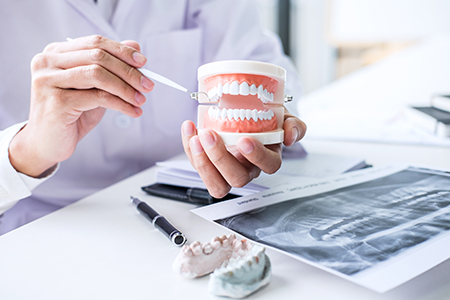
A successful denture begins with careful planning. We combine a thorough oral exam with diagnostic imaging and impressions to map the shape of the jaws and the relationship between upper and lower teeth. This preparation ensures the prosthesis supports comfortable function and a natural appearance.
Sometimes supplemental procedures are recommended before fabrication — for example, treating periodontal disease, extracting non-restorable teeth, or shaping tissues for a better-fitting base. These steps help create a healthier foundation for the denture and improve long-term outcomes.
Throughout fabrication, we focus on communication and precision: selecting tooth shade and shape that complements your face, verifying bite relationships, and refining fit during try-in appointments. The result is a prosthesis that reflects individualized planning rather than a one-size-fits-all approach.
When implants are part of the plan, surgical placement and prosthetic attachment are coordinated to ensure predictable retention and function. Whether your restoration is fully removable or implant-retained, our goal is reliable performance and patient comfort.

Receiving a new denture is the start of an adjustment period. It’s normal to experience increased saliva, mild soreness, and changes in speech during the first days or weeks. Guided practice with speaking and slowly reintroducing textured foods helps most patients adapt quickly.
Good home care is essential. Rinse and brush your dentures daily with a soft brush and approved cleaners, remove them at night to allow tissues to rest, and maintain oral hygiene for any remaining teeth and gums. Routine professional evaluations let us check fit, function, and tissue health and address wear or pressure points early.
Over time, the jaw and gums can change shape, affecting fit. Relines and periodic adjustments restore comfort and stability as tissues remodel. In many cases, proper maintenance and occasional updating of the prosthesis yield many years of reliable service.
For patients seeking added stability, implant attachments or precision components can significantly reduce movement and improve biting performance. We’ll review these options during your evaluation so you understand how each approach affects daily life and long-term care.
Mounts Dental Care is committed to guiding patients through the entire process — from initial consultation to adjustments and ongoing checkups — so your denture supports a healthy, confident smile for years to come. Contact us to learn more about how we approach denture care and which solution may be best for you.
Today, it’s easier than ever to replace missing teeth and achieve natural-looking, durable, and long-lasting results! Depending on a patient’s dental needs, lifestyle, expectations of care, and budget, choices can include conventional fixed bridgework, dental implants, or removable partial and complete dentures. At the office of Mounts Dental Care, we’ll discuss all your options in care and answer all your questions as you choose the solution that’s right for you.
With advances in dental materials and technology, today’s dentures are more comfortable and realistic-looking than ever before.
Whether you wear partial or complete dentures, it’s essential to see the dentist for routine care. Besides checking the fit and condition of your dentures and making any necessary adjustments, you’ll also receive a comprehensive exam to check on the health of any remaining teeth as well as the soft and hard tissues in and around the oral cavity.
A same-day denture offers an accelerated design and fabrication process that allows a patient to go from impression taking to denture insertion in a single day.
For patients who don’t want to wait after having teeth extracted, an immediate denture can be inserted the same day your teeth are removed. Sometime later you may need the denture relined to address any changes in its fit once the extraction sites have completely healed.
While no one wants to drop or break a partial or complete denture, accidents do happen. The good news is that in some cases, your partial or complete denture is reparable. It all depends on the extent of the damage. Don’t hesitate to contact our office if you’ve broken or damaged your denture. We’re happy to help.
The simple act of taking your partial denture in and out can cause certain types of metal clasps to loosen over time. When you come in for your checkup visit or contact our office for an adjustment, we’ll assess the fit of your partial and tighten the clasps for improved stability and comfort.
While rebuilding a complete smile is a worthwhile investment, our office is sensitive to the costs involved in dental care. We customize care and will discuss which treatment options address your needs, lifestyle, and budget. How much a new denture will cost depends on the type of the prosthesis, its design, and the materials used to fabricate the supportive base, teeth, and clasps or precision attachments. Dentures that include the placement of dental implants for added retention and stability typically involve additional costs.
If you have dental insurance, your coverage may include a new or replacement set of dentures. Our staff is happy to review your coverage with you to ensure you are maximizing your insurance benefits while minimizing any out of pocket expenses.
At the office of Mounts Dental Care, we provide an extensive range of dental services, including the latest and most effective methods to help patients with missing teeth rebuild complete and beautiful smiles. As skilled and experienced professionals, we recognize that every patient is different, and every smile is unique. We’re passionate about what we do and take great pride in providing personalized treatment plans while treating our patients as valued partners in care.
Dentures are removable prosthetic appliances that replace missing teeth and the surrounding gum tissue. They restore basic functions such as chewing and speaking while also supporting the contours of the face to improve appearance and comfort. Dentures are suitable for people who have lost several teeth or an entire arch and who prefer a non-surgical or removable solution.
Selection of a denture depends on oral health, the number and position of remaining teeth, jawbone condition, and personal goals for function and aesthetics. A comprehensive dental evaluation identifies whether a full denture, partial denture, or an implant-retained option is most appropriate. Your dentist will explain the advantages and limitations of each approach to help you choose a reliable restoration that meets daily needs.
Contemporary dentures benefit from advances in materials, digital planning, and laboratory techniques that create more natural-looking and comfortable results. Improved acrylics and tooth materials offer better wear resistance and lifelike shade matching, while precision impressions and bite records help position teeth for effective chewing and a natural smile line. Modern design also focuses on facial support so the prosthesis helps maintain lip and cheek contours.
Today's dentures are often easier to clean and maintain because they are designed for accessibility and hygiene. Additionally, combination treatments such as implant attachments can be integrated with removable prosthetics to increase retention and stability. These improvements make dentures a versatile option for many patients seeking function and aesthetics without permanent fixed restorations.
Removable dentures generally fall into three categories: complete (full) dentures that replace all teeth in an arch, removable partial dentures that fill gaps while preserving remaining teeth, and implant-supported overdentures that use implants to improve retention. Each type addresses different clinical situations based on how many natural teeth remain, the quality of the jawbone, and the patient's functional expectations. Within these categories there are variations such as flexible partials, overdentures retained by natural roots, and immediate dentures placed at the time of extraction.
Choosing among these options involves weighing factors like comfort, ease of cleaning, preservation of adjacent teeth, and the desire for added stability. Partial dentures can prevent shifting of neighboring teeth, while implant-retained options significantly reduce movement during chewing. Your dentist will review the clinical benefits and expected maintenance for each design before recommending a treatment plan.
Fabrication begins with a thorough oral exam, diagnostic imaging, and precise impressions to document jaw relationships and soft tissue contours. These records guide tooth selection, position, and the shape of the denture base so the final prosthesis supports speech, chewing, and facial aesthetics. Try-in appointments allow for verification of bite, tooth arrangement, and comfort before the laboratory completes the final prosthesis.
When indicated, preliminary treatments such as periodontal care, extractions, or tissue shaping are performed to prepare a healthy foundation for the denture. For implant-retained solutions, surgical and prosthetic phases are coordinated to ensure predictable retention and long-term function. The office of Mounts Dental Care emphasizes communication and step-by-step planning so each denture reflects individualized care rather than a one-size-fits-all approach.
An adjustment period is normal after receiving new dentures, and most patients experience increased saliva, mild soreness, and changes in speech during the first days to weeks. Practicing speaking aloud, starting with soft foods, and following gradual changes to your diet help accelerate adaptation. Minor sore spots can be relieved with adjustments during follow-up visits, and these early checkups are important for refining fit.
As tissues remodel, the denture may require relines or further adjustments to maintain comfort and stability. If movement persists or certain foods remain difficult to manage, your dentist can discuss options such as attachments or implants to enhance retention. Regular evaluations ensure the prosthesis continues to perform well as your oral anatomy changes.
Daily care includes rinsing and brushing dentures with a soft brush and nonabrasive cleaner to remove food particles and plaque, and removing them at night to allow tissues to rest. Keeping any remaining natural teeth and gums healthy with regular brushing and flossing is equally important to preserve oral health. Avoid using regular toothpaste on acrylic surfaces and do not soak dentures in hot water, which can warp the material.
In addition to home care, schedule routine dental checkups so your dentist can assess fit, tissue health, and wear on the prosthesis. Professional cleanings and periodic relines restore fit and comfort as the jawbone and gums change shape over time. Proper maintenance and timely repairs can extend the functional life of a denture and protect surrounding oral structures.
While removable dentures restore the appearance of teeth and support facial tissues, they do not prevent bone resorption as effectively as living tooth roots or dental implants. Bone naturally remodels when it no longer receives stimulation from chewing through tooth roots, which can lead to changes in facial contours over time. Well-fitted dentures can help maintain soft-tissue support and improve facial harmony, but they do not replicate the biological stimulation provided by roots or implants.
For patients concerned about long-term bone preservation, options that incorporate implants can provide the mechanical stimulation needed to slow resorption and improve prosthesis retention. Your dental team will explain how different restorative choices affect bone health and facial support so you can select a plan that aligns with your long-term oral health goals.
Immediate dentures are placed at the same appointment as extractions so the patient does not go without teeth during the healing period. The primary benefit is preserving appearance and basic function right away, which can be important for social and nutritional reasons. However, because tissues and bone change during healing, immediate dentures typically require subsequent adjustments, relines, or even remakes to maintain fit.
The trade-offs include a higher likelihood of follow-up visits in the months after extraction and the possibility of more temporary discomfort as the mouth heals. Your dentist will weigh these considerations against waiting for full tissue healing before fabricating a final denture and recommend the timing that best suits your clinical needs and personal preferences.
Implant-supported overdentures attach to small dental implants placed in the jaw to provide enhanced retention and stability while remaining removable for cleaning. The implants act as anchors that reduce movement during chewing and often improve bite force and comfort compared with conventional removable dentures. Candidates typically include patients with sufficient jawbone volume or those willing to undergo minor grafting procedures to support implant placement.
Determining candidacy involves a clinical exam and imaging to evaluate bone quantity, overall health, and oral hygiene capacity. The treatment plan can often be customized to use two or more implants for lower-arch retention or additional implants for greater stability in the upper arch. Implant-retained options provide a middle ground between fully removable prosthetics and fixed implant bridges, and your dentist will explain the expected benefits and maintenance requirements.
If you are considering dentures, begin with a consultation and comprehensive examination so the team can document your oral health, discuss goals, and review treatment options tailored to your needs. During this visit the dentist will evaluate remaining teeth, gum health, and bone condition, and explain whether a full denture, partial denture, or implant-retained solution is the best match. Clear communication about daily routines and aesthetic priorities helps guide material and design choices so the final prosthesis fits your lifestyle.
From planning and any preparatory care to fabrication and follow-up adjustments, the process is staged to prioritize comfort and predictable function. Regular follow-up appointments allow the team to monitor fit, tissue adaptation, and long-term performance, and to recommend relines or enhancements as needed. If you have specific questions about timing or the clinical steps involved, the practice can walk you through each phase to set clear expectations.